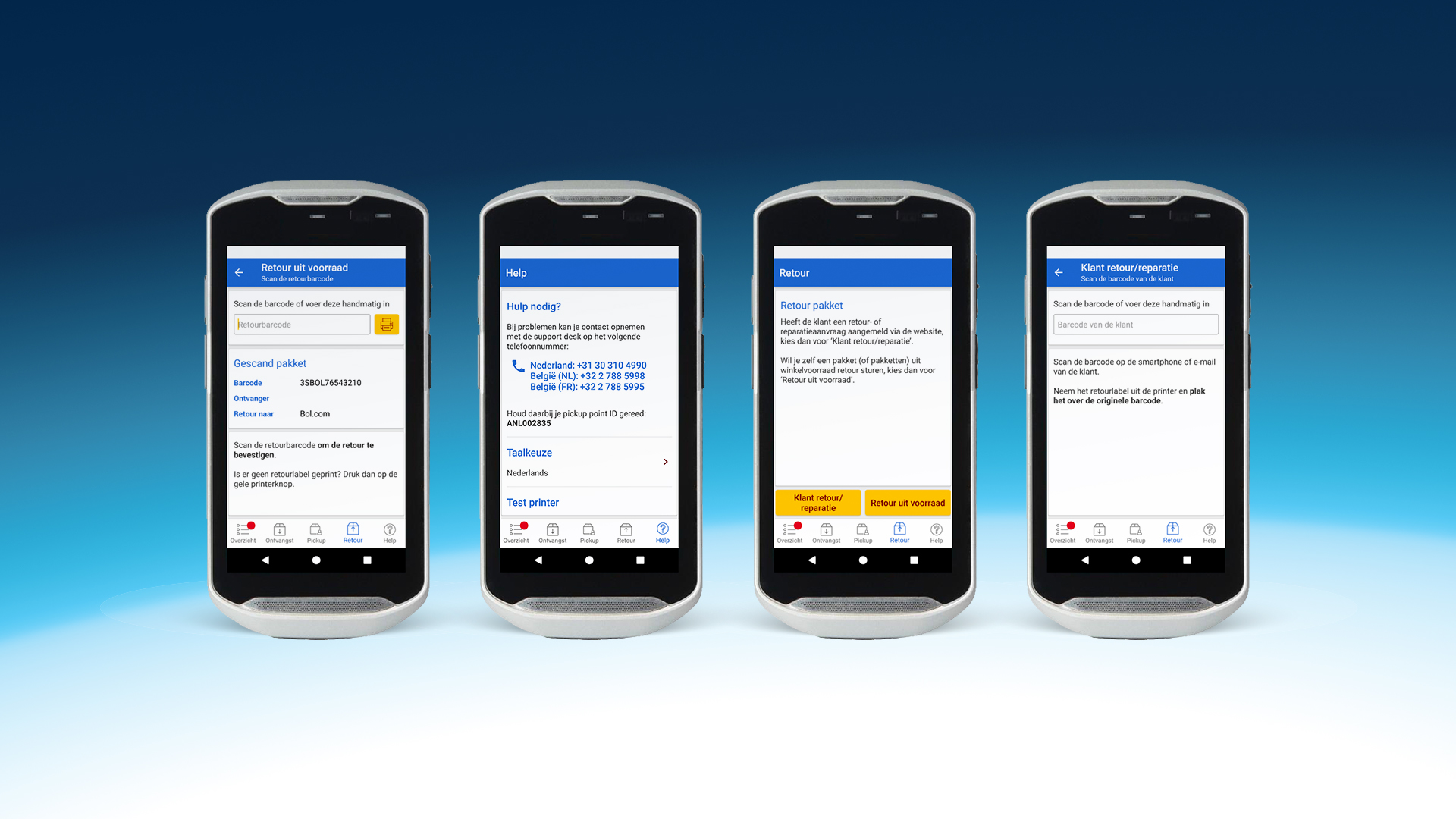
bol.com, the largest e-commerce company in the Netherlands and Belgium, needed to streamline the package handling process at its pickup points. Outdated systems were slowing down employees and increasing operational costs. We co-created a new platform, complete with a custom app, devices and microservices, that cut costs by 35% and significantly improved efficiency.
Challenge
bol.com employees weren't able to do their work efficiently: simple package drop-offs and pickups supported by the new pickup point platform were very time-consuming.
Solution
To address these challenges, we developed a complete pickup point platform tailored to bol.com’s needs.
Key features include:
- A fast, intuitive Android app requiring zero training
- A scalable architecture built on custom microservices
- Smart syncing and an action-driven UI that prioritizes urgent task
- Seamless integration with bol.com’s systems and logistics partners
- Support for future updates and feature expansions
The result? Faster package processing, higher accuracy, and more control.
Bol.com pickup points: package processing 2.0
E-commerce consists of two important elements: commerce, which is of course the main focus, but also ‘e’: internet. For an online shop, ICT is the backbone of its business. It need not come as a surprise that bol.com employs 300 developers, who work in 60 different IT teams. The bol.com website is not the only focus area: other operations demand smooth IT processes as well. In August 2016, bol.com saw a growing demand for pickup point deliveries and drafted a strategy to optimize the activities in the bol.com pickup locations at Albert Heijn and Etos in both the Netherlands and Belgium. One year later, over 800 stores are using new devices and a new app to process the packages carriers drop off and customers pick up.
The short timespan in which this was accomplished does not mean it was an easy ride. 15 different parties were involved, both internally and externally. At bol.com, these were business development, customer service, security, the pickup point IT team and the team responsible for informing customers about the status of their pickup point deliveries via e-mail and notifications in the bol.com app. Add to this a series of external parties, and you get an idea of the extension of the project. David Rauws, Product Owner & Senior Business Analyst at bol.com, was responsible for managing it from A to Z.
Before the start of the project, challenges lay ahead and the time was right for some innovations. The devices and app used at the pickup points were aging. The backend IT systems were managed by an external party. Bol.com wanted to upgrade the technology, make everything more efficient, and take control of the platform and its data. For the development of the new pickup point app, bol.com selected a partner. icapps turned out to be the perfect match for bol.com. Both parties felt a connection, a synergy in vision and way of working. “We wanted to find a partner that thought along with us, but that was also able to build a really good app,” says David Rauws. “icapps has the right experience, competitive pricing and it just felt right. We quickly noticed that both our companies have the same work ethos: let’s roll up those sleeves and go for it!”
First things first: the design phase
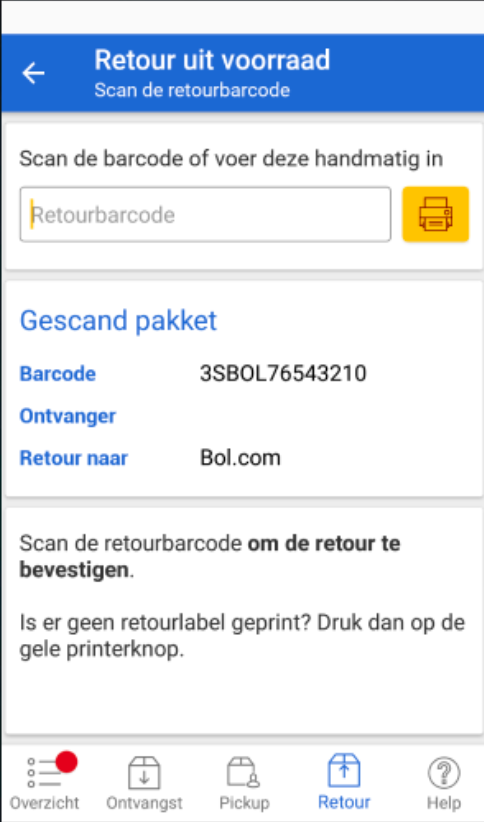
In January the design phase was kicked off. In about six weeks’ time, a team of icapps UX designers and developers and the bol.com development crew built the framework of the app. Every day they spent hours going over the processes that employees go through in the pickup points. All possible scenarios were taken into account and technical decisions were made. David Rauws: “What I really valued was the speed and dedication of the icapps team. If you sent an email or gave a quick phone call, they always made sure to respond swiftly. Scrum and agility really are deeply rooted in icapps’ DNA, just like they are in ours.”
One of the non-functional requirements was very simple: no training. This meant that the app would have to be very intuitive. Therefore, the goal was to translate the old way of working 1-on-1 to the new system, as much as possible. Of course, user-friendliness and look and feel were much improved and there were some new features, like automatic data sync and an action-driven app structure (actions with the highest priority on top). “The no-training requisite was definitely challenging,” admits David Rauws, “but the satisfaction of pulling this off is all the bigger. We were able to roll out 850 stores in only 6 weeks’ time, quite an achievement of which all parties involved can be proud.” icapps also made sure to prepare the app’s framework for potential future feature additions.
Not your typical app development lifecycle
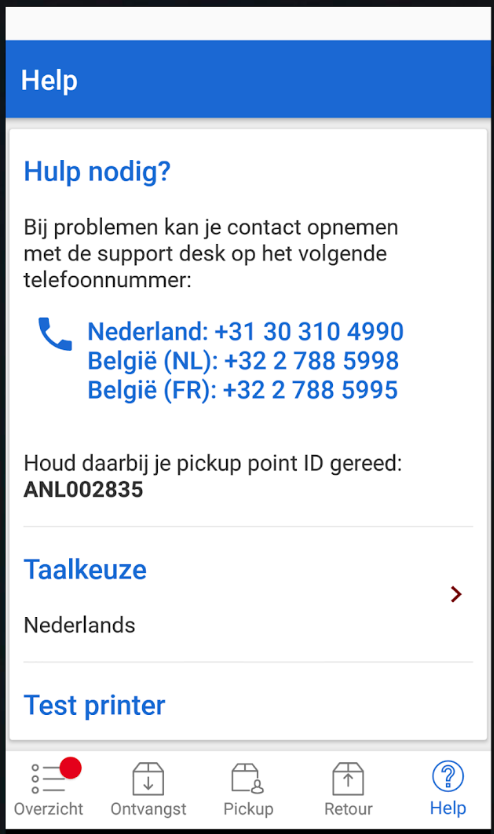
In between the design phase and the rollout were several months in which a lot of practical implications were taken care of. Think of connecting warehouses and carriers, optimizing first and second line support, arranging in-house functional application management and communication towards the pickup points. The actual rollout that was spread over 6 weeks, was a different way of working than what icapps is used to. Lander Spruyt, Project Manager at icapps: “Normally an app is developed, tested, finalized and then delivered and loaded to the App Store. After this cycle, there is a period of warranty in which potential problems can be reported and fixed. With the bol.com pickup point app the rollout took several weeks, so it only made sense to be flexible and split the period of warranty over several periods of time.”
35% cost savings
In addition to enabling employees at pickup points to work more efficiently, there were several other reasons why this was a very valuable project for bol.com. “First of all we have gained independence by building an in-house pickup point platform. Secondly, there is the story of the data that we now dispose of. Operational data on the number of packages being sent, picked up and returned, but also technical insights into the performance of our micro services. Data ownership and security are very valuable in this day and age. And then finally there is the cost,” concludes David Rauws. “Thanks to this new way of working, we save around 35% in operational costs. What’s even better is that the savings will only increase over time. In the past, every new pickup point incurred the same high amount of additional costs. Now that we have taken control with our own scalable platform, a new pickup point means only a slight increase in operational costs.”