Sander Hofman is stepping into the role of Managing Partner at icapps. After a year as Head of Technology, he now takes on a broader leadership role, helping icapps guide into its next chapter.
Over the past year, Sander has been closely involved in strengthening how we work, from the way teams collaborate to how we support clients. His approach is simple: build strong foundations first, then grow with confidence.
Below, he reflects on what he learned and where we’re heading.
You’ve been Head of Technology at icapps for a year now. What have you learned over the past year?
“Quite a lot (laughs). When I started, I was eager to accelerate everything, processes, tooling, technology… But I quickly realized that you can’t speed up without a solid foundation. Over the past few years, our rapid growth meant that we had, unconsciously, overlooked basic processes like standards, testing, deployments, and even our own IT infrastructure.
So my first year was really about deliberately slowing down, sitting with people, listening, and rethinking the way we work. It might not sound flashy, but the results speak for themselves. Today, we have a clear understanding of how we work, where bottlenecks are, and how we can improve. And that prepares us to move forward faster.”
At icapps, technology is never a gamble. What does that really mean?
“It means we don’t chase hype. Everything starts with understanding the business needs. What is the customer trying to achieve, what works already, what doesn’t, and what fits their specific context? We have a proven technology stack, but we always adapt it to the client’s reality, based on our collective expertise.
Of course, we explore new technologies constantly, but we adopt them only when they truly add value. We don’t just ‘do something with AI’ because everyone else is. Our clients need to benefit today and in the long term. Striking that balance is our responsibility as a technology partner, and it’s exactly why our clients trust us.”
“You can’t keep building on a shaky foundation” – what’s the biggest misconception about innovation?
“That it needs to be flashy, big, or special. Real innovation is often invisible. Take a recent project in the Port of Antwerp, for example. We implemented speech-to-text so dockworkers don’t have to type orders on a tablet, they can keep working with gloves on. That’s innovation. It might not look spectacular, but it delivers huge efficiency gains. Innovation should be smart, not loud.”
How do we turn that into tangible impact for our clients?
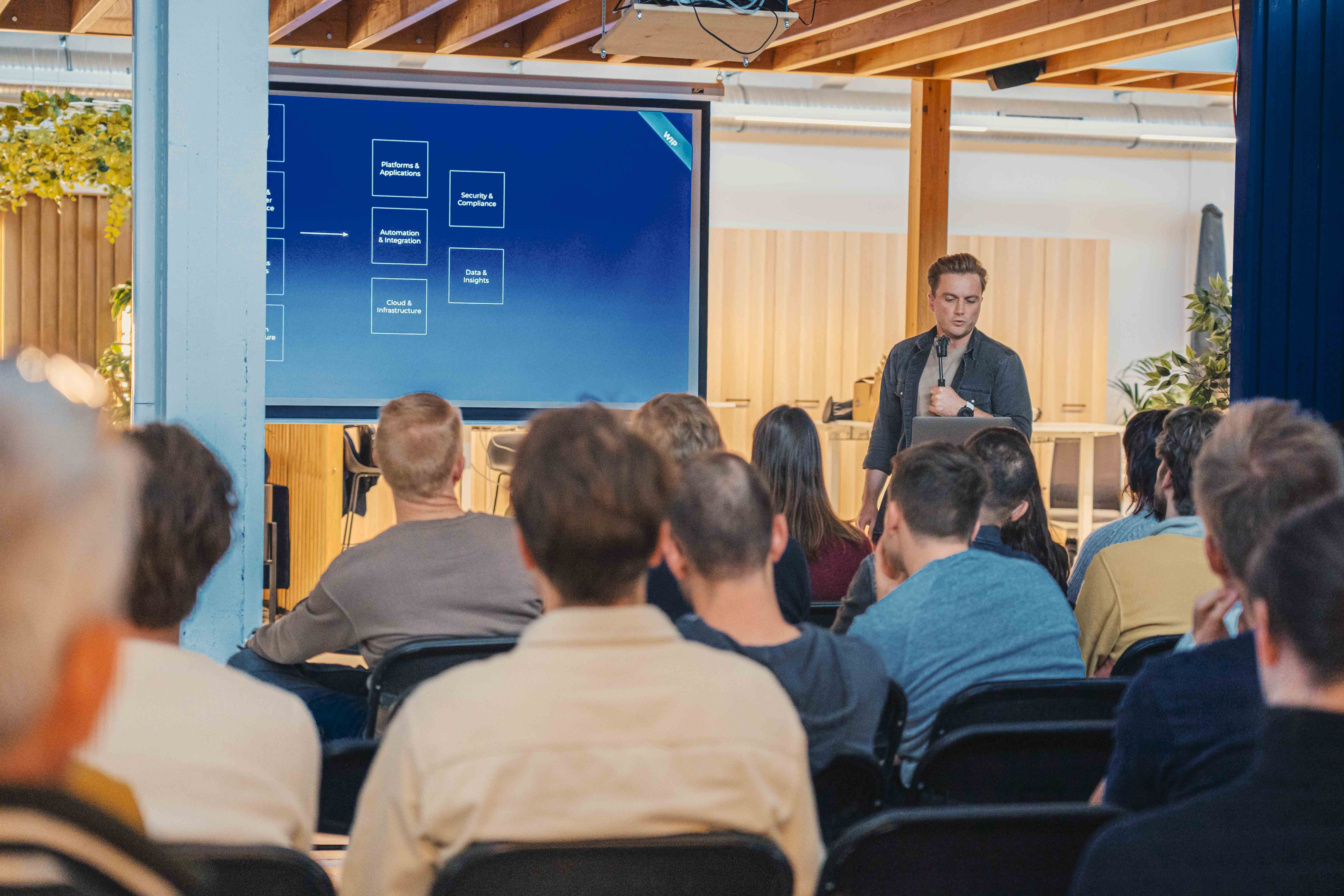
“By diving deep into their processes and business architecture, not by immediately jumping into technology. For every client, we start with: what goals need to be achieved, what processes currently support them, and where are the pain points? From there, we translate insights into clear Quality Attributes. These become the foundation for future solutions and guide our technology decisions. That way, quality is based not on gut feeling but measurable criteria linked directly to the client’s objectives.”
How do we help clients distinguish what works from what’s just hype?
“By being critical. If a client says, ‘we want to do something with AI,’ our first question is always: why? What should it achieve? Technology only makes sense in the right context. If a client is still struggling with basic processes, AI won’t magically fix it. We often play devil’s advocate, not to be difficult, but to ensure sustainable impact.”
Is security a brake or an accelerator?
“Undoubtedly an accelerator, but only if it’s integrated from day one. Not as a checklist afterward, but as a structural part of design, delivery, and monitoring. Our ISO 27001 certification confirms that we work according to international information security standards. That builds trust, both internally and with clients.”
icapps is also heavily invested in application modernization. Why?
“Many companies still rely on legacy systems that slow down growth. You can’t keep building on a shaky foundation. Modernization isn’t just rewriting old code; it’s about rethinking the entire digital ecosystem, data flows, integrations, security, consistent UX across touchpoints… Yes, it’s complex, but that’s exactly where we excel. We combine modern architecture with strong engineering standards and a multidisciplinary team capable of bridging different domains. We’re doubling down on this next year because it’s a challenge we truly love tackling.”
Where else will you strategically focus in the coming years?
“In tech, companies usually sit at extremes: hyper-creative and disruptive, or robust and delivery-focused. We consciously choose the middle path, we combine innovation and design with engineering excellence and strong governance. We build digital platforms that are user-friendly, scalable, and demonstrably impactful. In the past, our hybrid nature seemed like a disadvantage. Today, it’s our strength, and that’s what we want to emphasize more in the coming years, because sustainable impact comes from that sweet spot in the center.”

